
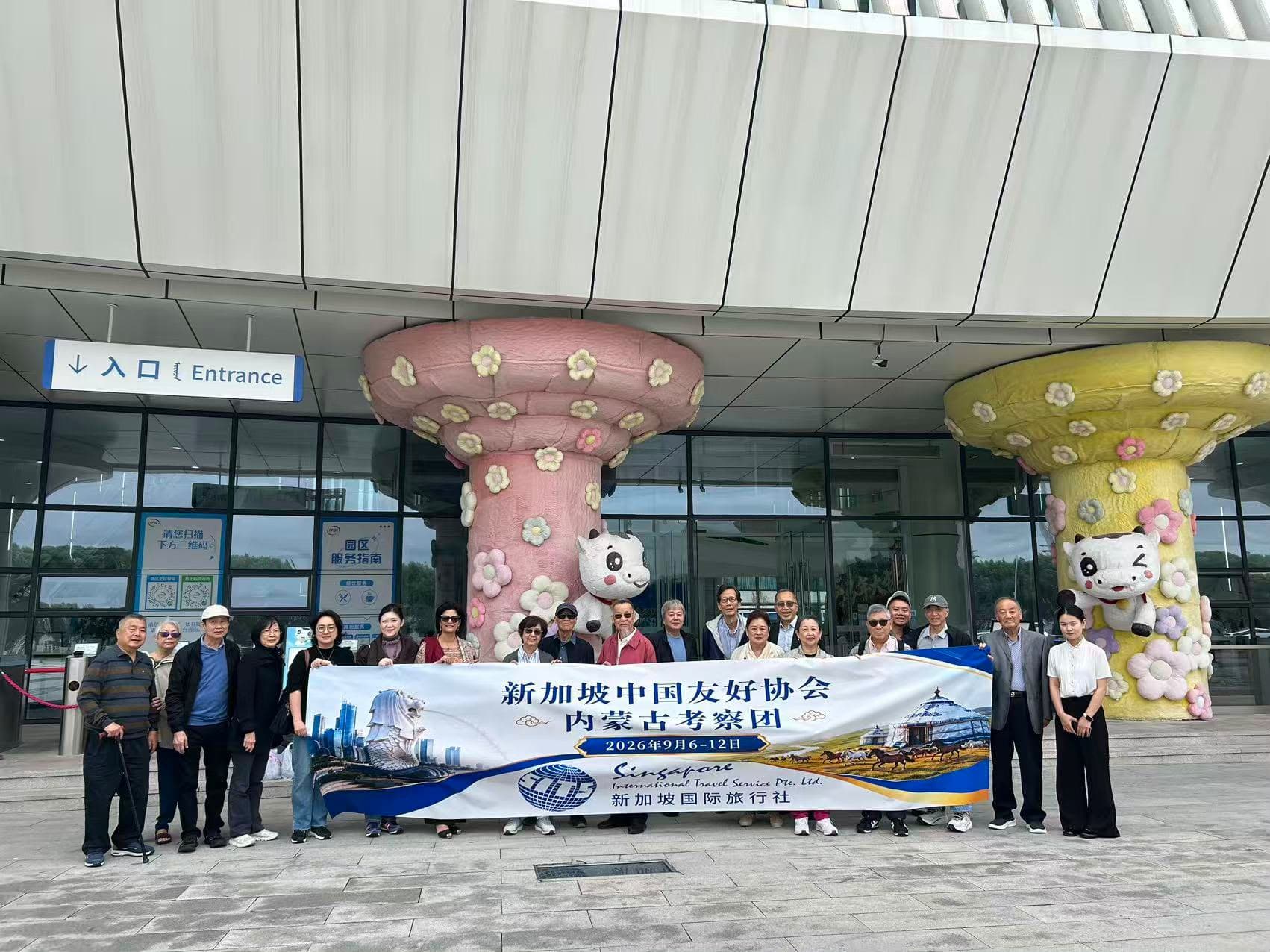
September 6–12, 2026
SCFA Visit to Inner Mongolia
View 23 event photos ↓From 6 to 12 September, a 32-member delegation from the Singapore-China Friendship Association (SCFA) visited Inner Mongolia for seven days of friendly exchanges and study visits, thoughtfully arranged by our longtime friend Wang Shouzhi.
The delegation included the following leading members of the Association’s Council:
Ng Yan Huay, Ong Eng Chang, Ng Swan Meen, Hoon Tai Meng, Giam Meng Tuck, Ang Teck Sin, Naseem Jumabhoy and Chen Yihan, together with members and friends who have consistently supported the Association’s activities.
Our Taiwanese friend, science journalist and author Chiang Tsai-chien, also flew specially from Taipei to Beijing to join the delegation. In January this year, he delivered a special lecture for the Association to mark the 100th day since the passing of Yang Chen Ning.
Eager to explore Hohhot, Baotou and Ordos—the three cities of central Inner Mongolia’s ‘Golden Triangle’—and to experience the grasslands, desert and rich historical and cultural heritage, we set off from Singapore on this long-distance journey of friendship and exchange.
An overview of the visit
Over seven days, we enjoyed Inner Mongolia’s vast and magnificent natural scenery and deepened our understanding of its history, culture, ethnic traditions, industrial development, ecological restoration and modern urban development. Through visits, discussions and first-hand experiences, we further strengthened mutual understanding and friendship between the people of Singapore and China.
Particularly worth mentioning was the warm reception and strong support extended by the relevant authorities of the Inner Mongolia Autonomous Region and the cities of Hohhot, Baotou and Ordos. Meetings, visits and hosted meals provided opportunities for in-depth discussions with our local counterparts.
These exchanges enriched the visit and showed how much our hosts in Inner Mongolia value people-to-people friendship between Singapore and China, as well as their enthusiasm for promoting it.
For Council members and friends who could not join us, we hope this illustrated account will bring back what we saw, heard and experienced, allowing everyone to take a ‘virtual journey’ through Inner Mongolia and share this fulfilling and memorable visit.
6–7 September | Hohhot
Delegation members travelled on Singapore Airlines or Air China, arriving in Beijing in the afternoon before transferring to an Air China domestic flight to Hohhot.
The delegation first visited Yili Modern Smart Health Valley.
The impressive scale of Yili Group’s production facilities gave us a more direct understanding of modern manufacturing, smart management and the development of the health industry. It also offered a glimpse of the changing face of modern industry in Inner Mongolia.
At noon, Hohhot Executive Vice Mayor Liu Jiying and his wife hosted a welcome lunch for the delegation. The gathering took place in a warm and friendly atmosphere, providing a positive opening to our exchanges in Inner Mongolia.
After lunch, we visited Zhaojun Museum. Historical artefacts, photographs and exhibitions introduced the story of Wang Zhaojun and her lasting influence on exchanges and cultural interaction among ethnic communities.
On the same day, Pang Hui, Director of the Foreign Affairs Office of the Inner Mongolia Autonomous Region, and Wang Kun, Vice Mayor of Hohhot, jointly hosted a dinner for several SCFA Council members. They were joined by Zhou Jianhua, a second-level inspector of the regional Foreign Affairs Office; Chen Gang, head of its friendship association division; Chen Chao, head of its international cooperation division; and Wulantuya, Director of the Hohhot Foreign Affairs Office.
In a relaxed and cordial setting, both sides discussed ways to further promote people-to-people friendship between Singapore and China.
After dinner, the delegation tasted the local speciality shaomai and watched the ethnic song-and-dance production Chile Changge: Zhaojun, specially presented for us. Advanced laser effects and sound accompanied a performance of exceptional artistic quality. Light rain fell that evening, yet the cast continued to perform with great dedication. Their commitment moved us and left us with wonderful memories.
From modern industry to historical heritage and the performing arts, a single day gave us a multifaceted understanding of Hohhot.
8 September | The museum and Xilamuren Grassland
The delegation visited Inner Mongolia Museum.
Its extensive collections and exhibitions introduced the region’s history, natural environment and ethnic cultures, helping members understand the development of this land from different perspectives.
The delegation then travelled to Xilamuren Grassland.
As we left the city, vast grasslands opened before us. Blue skies, white clouds, green pastures and an expansive horizon gave those of us from Singapore a vivid sense of the distinctive grandeur and openness of the northern grasslands.
First-hand experience also helped us better understand the grassland ecosystem and the local natural landscape.
At Happy Ranch, members put on traditional Mongolian clothing and experienced Mongolian life and traditions.
From tasting milk tea and learning archery to listening to the morin khuur, or horsehead fiddle, and taking part in an ovoo ceremony, these relaxed and enjoyable activities brought us closer to Mongolian traditions and the grassland way of life.
In the evening, we enjoyed a traditional Zhama banquet and checked into distinctive grassland yurts. Afterwards, we also joined an exciting bonfire gathering.
After nightfall, the grasslands became especially peaceful, far from the city lights.
Spending a cold night in a yurt was another rare and special experience on this journey.
9 September | Baotou
We left the grasslands and travelled by coach to Baotou to experience the development of a modern industrial city.
On arrival, we first visited Baotou Iron and Steel (Group) Co., Ltd. We learned about the development of local modern industry, the steel sector’s important role in the city’s economy, and the company’s significant contributions to aerospace. Its advanced technology was truly eye-opening.
With its long industrial history and close links to China’s modernisation, Baogang was a highlight of the programme.
The delegation then visited the Baotou Municipal People’s Government for exchanges with local officials.
Participants included Jin Yongli, Deputy Secretary-General of the Baotou Municipal People’s Government; Zhao Ya, Director of its Foreign Affairs Office; Yang Liping, Deputy Director of the municipal Development and Reform Commission; Hu Yanling, Chief Education Inspector of the Education Bureau; and Zhao Jing, Director of the Port Services Centre. Discussions covered urban development, education, industry and external exchanges.
The meeting deepened our understanding of Baotou as a modern industrial city and offered insights into Inner Mongolia’s efforts in industrial development, urban construction and industrial transformation.
Travelling from the grasslands to an industrial city within a day also highlighted the different development characteristics of Inner Mongolia’s cities and their approaches to combining traditional resources with modern industry.
10 September | Xiangshawan and ERDOS Group
The delegation visited Xiangshawan Desert Park, a nationally rated 5A tourist attraction.
The experience left a particularly strong impression. Transport connections within the attraction were exceptionally smooth, making the visit almost entirely seamless and hassle-free.
From cable cars to the ‘ships of the desert’ and then a small train, members reached the park’s central recreation area with ease.
In the heart of the desert, members enjoyed camel rides and attractions including a desert version of a roller coaster. For those accustomed to city life, these distinctive activities amid the open sands brought much laughter and became some of the happiest memories of the trip.
On the journey to and from Xiangshawan, we also observed the results of desert rehabilitation around the park. Changes in the surrounding landscape gave members a more direct understanding of Inner Mongolia’s efforts in ecological protection and desertification control.
That afternoon, the delegation visited ERDOS Group to learn more about the development of a distinctive local industry.
Beginning with high-quality local Albas cashmere, ERDOS Group grew steadily into a diversified enterprise spanning the full industrial value chain.
The growth from a distinctive local resource into a diversified business covering the full value chain showed us that Inner Mongolia, in addition to its vast grasslands and abundant natural resources, is actively developing industries around its distinctive resources.
In the evening, the delegation dined at Lianglangjing Restaurant in Kangbashi. Afterwards, at the invitation of the local foreign affairs authorities, we enjoyed Kangbashi’s nightscape and musical fountains.
The modern city lights against the night sky revealed another side of urban development in Ordos.
11 September | History and technology in Ordos
At Ordos Museum, members learned more about the city’s history, culture and regional characteristics, gaining a fuller understanding of its development.
The delegation then experienced KargoBot’s autonomous-driving operation.
Moving from historical heritage to modern technological innovation, this project introduced the city’s exploration of smart transport, autonomous driving and other new technologies, adding a perspective on innovation and future development to the visit.
The delegation then visited the Ordos Municipal People’s Government for exchanges with local officials.
Ordos Vice Mayor Zhang Xiuling attended with Hao Yun, Director of the municipal Foreign Affairs Office; Zhang Ning, Deputy Director of the Education and Sports Bureau; Yao Zhaohua, Deputy Director of the Industry and Information Technology Bureau; Li Zhihong, Executive Deputy Director of the Commerce Bureau; and Zhao Xingguo, a second-level researcher at the Culture and Tourism Bureau. At noon, the municipal government hosted a welcome lunch, during which both sides enjoyed warm and friendly conversations.
These exchanges helped the delegation better understand developments in education, industry, commerce, cultural tourism and external relations in Ordos.
In the afternoon, the delegation visited the Mausoleum of Genghis Khan.
This historically and culturally significant site deepened members’ understanding of Mongolian history and culture and added a strong heritage dimension to the journey.
In the evening, the delegation dined together at He Fuji in Kangbashi, bringing the friendly exchange visit to Inner Mongolia to a relaxed and enjoyable close.
12 September | Reflections on a rewarding journey
We concluded our visit to Inner Mongolia and returned from Ordos to Singapore via Beijing.
Seven days had passed quickly, but the journey had offered a wealth of experiences.
Throughout the trip, we travelled in comfortable, luxurious touring coaches, enjoying a rare opportunity to admire the Yinshan Mountains along the way. The scenery brought to mind a quatrain by the Tang frontier poet Wang Changling:
The moon of Qin still shines on the passes of Han;
Those who marched ten thousand miles have not returned.
If only the Flying General of Longcheng were here,
He would not let the northern horsemen cross the Yinshan Mountains.
From Hohhot’s historical heritage and modern industry, we moved on to the expansive Xilamuren Grassland and its ethnic traditions. In Baotou, we learned about modern industrial development. At Xiangshawan, we enjoyed desert adventures and observed the changes brought by ecological restoration along the way. At ERDOS Group, we followed the growth of Albas cashmere from a local resource into an industry spanning the full value chain. Museums, government institutions and modern technology projects offered further perspectives on Inner Mongolia’s history, urban development and technological progress today.
Yet the most important significance of the visit went beyond what we saw.
This was a high-quality study and exchange visit, rather than an ordinary sightseeing trip.
The Association should organise more visits of this kind and encourage younger people to take part.
Each such exchange strengthens connections among our members and sustains people-to-people friendship between Singapore and China.
We thank the relevant government departments and all our hosts in the Inner Mongolia Autonomous Region, Hohhot, Baotou and Ordos for their warm reception, strong support and thoughtful arrangements. We also thank every Council member, member and friend who participated in or supported this visit.
We look forward to setting out again on our next cultural journey!
Event in pictures
1 / 23Choose a thumbnail or use the arrows to explore the gallery.